I can't argue much with science because I don't have any proof counting calories doesn't work-- but then again, that isn't what I am arguing. I've counted calories myself. And it has worked. It also made me a food Nazi, and not in a good way.
When I first started counting calories 9 years ago, I thought it was the best. I knew exactly what I was eating every day. I felt in control of my eating habits. I knew I was going to lose weight, I could prove it!
Then came the psychosis. One day I had 20 calories left to eat to be in a 200 calorie deficit. "Just leave it alone," I told myself. "The more of a deficit you create, the faster you will lose weight." But it didn't end there. Soon it was 50 calories under, then 100, then 200. I was slowly drifting into a "if less is good (in this case), even less it better." I stopped going out with friends. I spent my free time adding my food choices to an online database to keep track. I basically did nothing else with my life for that brief time. Then one day I just stopped. The pounds that I didn't even need to lose stopped looking like they were coming off. The reward no longer outweighed the seemingly impossible goal (six pack abs). And my life had become boring and unfulfilled. How did I get this far?
It's not uncommon, really. Especially if you have strong willpower. Many times people take counting calories too far. In fact, you could argue that counting calories to the last gram is a kind of neurosis. It's too micromanaged. It doesn't really work that way, health I mean. Not one of our ancestors ever sat and thought what a calorie even is. I'm sure they had sensations of overeating, or under eating. But I can't imagine that before bed they pondered if they got the low fat diary or the high fat, and if it was going to cause their calorie skews to go out of whack. That is usually where I like to bring people when I talk about this calories in, calories out business. But it doesn't always win the argument, cause they open up their phones or computers and show me the body of someone who counted calories and lost a ton of weight. At that point I don't even begin to argue counting calories
won't work, because they are right. It does work. It does. If you want to go about it that way, which is a lot of work, you can. But for those of you who don't, there are some easier solutions, and it works in a baby step process.
Step 1: Track Your Meal Patterns for a Week

This doesn't have to be a crazy journal or anything. It could simply be a chart that has three squares for each day spread out through a week. All you need to do is describe what you ate. So if you had eggs, toast, bacon, and OJ for breakfast, you'd write that all in. Be honest with this. The point isn't to hide habits, foods you love, or anything you think might be judged. After all, you are the one who wants to make a change, and the person you are working with should be gentle with that. Not everyone can or should go cold turkey. After that week is done, give the list to the trainer or nutritionist you are working with. If you were working with me, the first thing I would do would be to ask you what your favorite foods are. Then I would ask you your typical weekly schedule (work hours, free time, bed time, etc). From there, I would set up a goal system with you that works with that you want, not necessarily what you "should" do. See, too many times trained professional will look at what a person eats and think, "oh, all you need to do here is eat more veggies, fruits, meats at dinner, cut back on the fast food, and you'll be fine." No way! Someone get the Noble Prize, this has never been thought of before! A strategy I think works is to look at the chart and count meals the client would say are junk food or not. I think it is important for the understanding to be there, and if you have her or him make that connection what they are eating, it doesn't just become a "here, fix me," type of mentality, it becomes a learning experience. This is ultimately the goal. So we have counted the number of junk food meals in a week. Typically if you are eating 3 meals a day, you will have 21 meals in the week. Let's say out of the week, our example client had 10 junk food meals out of 21. That's about 50%. In my opinion, that isn't bad, especially for someone who works a 9 to 5, or has kids, or doesn't know how to cook. Those are all things we can work around, but we aren't going to make the client feel like they have failed. Defeating attitudes never make a person better. So we have 10 meals that we want to look out to see if we can make changes. Again, the client is coming to me, for example, saying, "I want to change, help me figure out how." Based on whatever the number of junk food meals there are, I set up a plan for achieving a reduction in the amount of cheat meals. And I do this very slow. Every two weeks, I suggest that this person try to cut one junk food meal out of their week. In this case, we will only be cutting out 4 meals out of her or his currently existing 10. So over 12 weeks we are going to try to cut down to 4 junk food meals a week. Now, that might even be too low. Cause think about it, its the weekend, you are probably going to go out, and you will likely eat or drink something you would consider "junk." Maybe not, but we want to create a reasonable window. For example, three meals on the weekend you eat out-- Friday and Saturday night dinner, sunday morning breakfast. Now you have one meal left during the week if you forget to bring lunch, are in a rush, whatever. That might be too low for someone. So you let them experiment with it. Tell them to not worry about keeping that number 4, but if you can, strive for that to be the highest. They come back a week later and write that they have had 6 junk food meals in the week. This is perfectly fine, and you want to reassure them of that. Because the last thing you want to do with someone who is already making sacrifices is make them feel like what they have achieved so far is some how all for nothing. What I would do as a trainer is ask them about the 2 "extra" junk food meals they had. I want to know the story. Most the time, its cause they were busy. Work got crazy. Their kids had to go to a piano lesson and the only thing they could grab was something leftover from the last cheat (junk food) meal. So they did, cause eating is better than not eating. These are the stories I love to hear, because it means my client really did the best they could at the time. And I would never fault them for that. This is where the next preventative step comes in, meal prepping
Step 2: A Different Look at Meal Prepping

I would imagine just about everyone understands the concept of meal planning. What I don't think most people realize is that it doesn't have to be a entirely boring process, and that the food has to be bland and flavorless. If you are like the person in our above example, you eat out more than you'd like, and you want to do something about it. Another small step in achieving this goal is to cook the majoirty of your food, pack it away, and have it lined up for the coming week. The kind of meals you plan, at this stage, don't necessarily matter. Yes, we eventually we want to be eating healthier, but it is more important to start off making your own food, food you enjoy the same as junk food, but making it at home. Home cooking, believe it or not, is vastly more healthy than junk food, even if that food is basically the same, and often times cheaper than purchasing food at a diner, restaurant, or fast food joint. For example, lets say you love pasta. Pasta alone is a relatively simple dish. You have pasta noodles, sauce, some veggies if you want, and that is about it. If you buy that in bulk at the store, you will likely have two or three meals lined up for the price of one meal at an Olive Garden or Pasta Rev (I call dibs if that isn't a real place yet). By making your own food, you not only cut on food costs, but you likely wont be getting all those unhealthy additives they put in packaged foods. And you might not think additives due much to your health, or weight loss, but they do. Often times I find that if I ask a friend or family member to try removing one additive from their diet, they see a decrease in the number of headaches. That is because a lot of additives cross the blood brain barrier, seeping into your brain and causing inflammation. The key take away from this is: make your favorite meals at home first without sacrificing taste, calories, or macronutrients (carbs, fats, and proteins).
Step 3: Macronutrient Balance
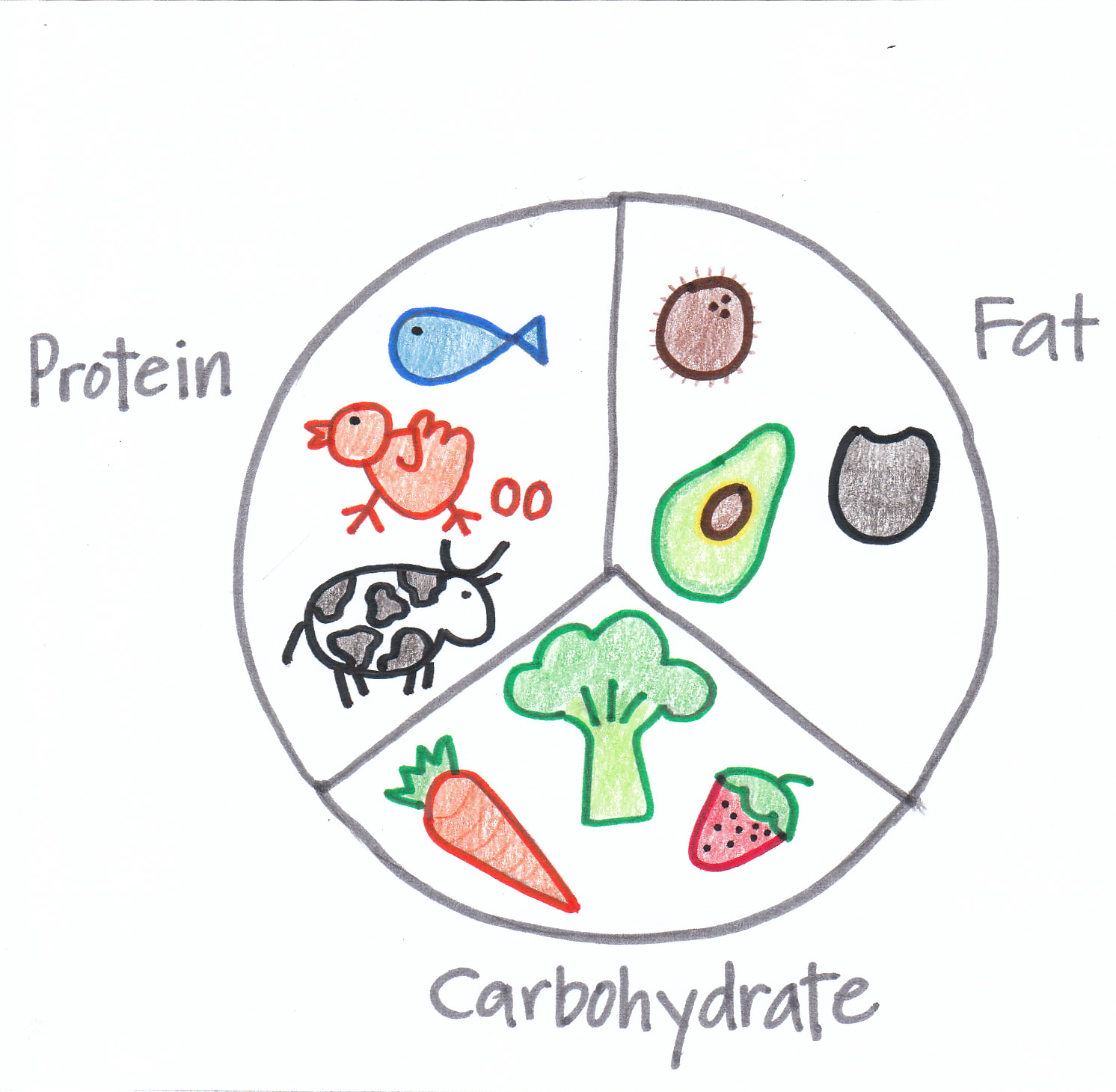
Realizing the carbohydrates, fats, and proteins that you eat as causing your blood sugar (mood) to change is a very powerful tool. It is the next step of awareness once you have regulated the first two steps in this process. Believe it or not, although all food seems organic (meaning it comes from the earth, it is whole, and it is unlike that plastic fruit your grandmother keeps in her kitchen)-- not all food is the same. Yes, they might have similar nutrient profiles, but they can be misleading. Behinds the scenes, a lot is going on. A great example of this is dietary fat. For the longest time, people thought that saturated fat was the devils nutrient. This came about based on a study done by a man named Ancel Keys. The long and short of it is: Ancel went to a bunch of countries to see what overweight populations were eating. He documented these studies, but he didn't do it honestly. What he published was that saturated fat causes obesity in populations around the world. Problem is, this wasn't true everywhere. What was true was that some populations who consumed saturated fat were obese, and some populations that consumed saturated fat were in fact perfectly healthy. Why he was biased toward saturated fat causing disease and obesity is beyond me, but if I had to speculate, my theory is he was told to find it to promote the sales of vegetable oils, making some people very rich. That's just a theory though, I don't really know. But enough with the history lesson. The point is this: not everything we are told in the media in regards to health (or anything really) is true, and we should seek out those independent studies for a better idea as to what is going on. This is true for all the macronutrients. Another big one is carbohydrates. After fat took its turn at being the bullied kid at school, carbohydrates stepped in. With the rise in national disease, unhealthy weight gain, and early death, carbohydrates was the main dietary culprit. But why is this? Well, generally speaking, America eats a ton of food, period. Even when our macronutrients are balanced, we eat more than most countries. So that plays a roll on the whole. The other easy thing to see, if you have ever eaten carbohydrates, is they are really easy to consume, let a lone find. They are in everything, and they don't satiate you very well, cause by the time they get into the stomach, they are basically broken down into nothing. It is similar to how watermelon sized meteors break down in our earth's atmosphere; by the time they get to the surface, they are barely recognizable with a human eye, or even felt or tracked. So image this going on in your body. If you notice, when you eat a lot of carbohydrates, you really don't "feel" it until it is too late, and then you regret it. Trust me, I know. I love both ice cream and potatoes, and I have had many bouts with this phenomena. So why doesn't this happen with protein or fats? Well, in the simplest terms, think about the structure of protein and fat. I'm no chemist, but I know just from touch, and mouth feel that, generally, protein is pretty chewy and dense, and fat is just about the same with a little more fluidity (meaning, at least to me, that it can change forms-- liquid to solid and back again-- relatively easily). If you imagine each of these macronutrients individually, it is easier to understand how they interact in your body. I know this isn't hard science, but that isn't the point. If you apply this linear model, you can see how it is not carbohydrates that is to blame for Americas obesity, but you can say it makes sense why it is being blamed, Carbohydrates are perfectly fine most the time, but they are also the most altered and broken down food in the world. Types of carbohydrates will be covered in a separate post. All you really need to do is tweak your understanding, and you can fix the problem, at least seemingly. So, what is the take away point from this step? Eat your meals and snacks with a balances of all three macronutrients to avoid spikes in blood sugar (mood swings) and you will be on the path to a balanced and a healthier lifestyle.
After reading over this post, I realize I have covered a lot of information so far. In the name of not overwhelming anyone interesting is following this step by step approach, I will write about more techniques to sticking to your health goals in another post. This will also give me more time to condense the information I've learned. In conclusion, I appreciate that you read this article, and hope to find you in better health in the future.



No comments:
Post a Comment